Thursday, March 29, 2012

APOD 4.1

3/29/12
Rocket Trails in the Milky Way
See Explanation.  Clicking on the picture will download
 the highest resolution version available.

Two days ago, NASA launched five sounding rockets from the Wallops Flight Facility located in Virginia.  This photo shows the clouds that the chemical tracer left by the rockets in the Earth's ionosphere (starting at about 80 km).  The clouds were able to be seen in the mid-atlantic (this picture specifically captured in New Jersey).  Sagittarius and Scorpius are also visible in the background of this picture.

Tuesday, March 27, 2012

Observations

3/27/2012
     Yesterday, we were told in class to step outside (at night) to see Jupiter and Venus in conjunction because it was the last night we would have a good view of this event.  Although I had seen this over spring break pretty clearly since I was able to stay up later, I decided to go out last night and look for Jupiter, Venus, and the moon.  I drove a bit past my neighborhood since it is well lit and once I got to a spot on the road where it was dark I pulled over (I was not alone) and stepped out of my car.  I was able to see Jupiter and Venus in a straight line with the moon rather clearly.  My mom (who was with me) was also able to see it and she was quite surprised because she really has no idea what to look for.  It was definitely an interesting and beautiful thing to see/share and I'm glad there was something different to observe.

Sunday, March 25, 2012

APOD 3.8

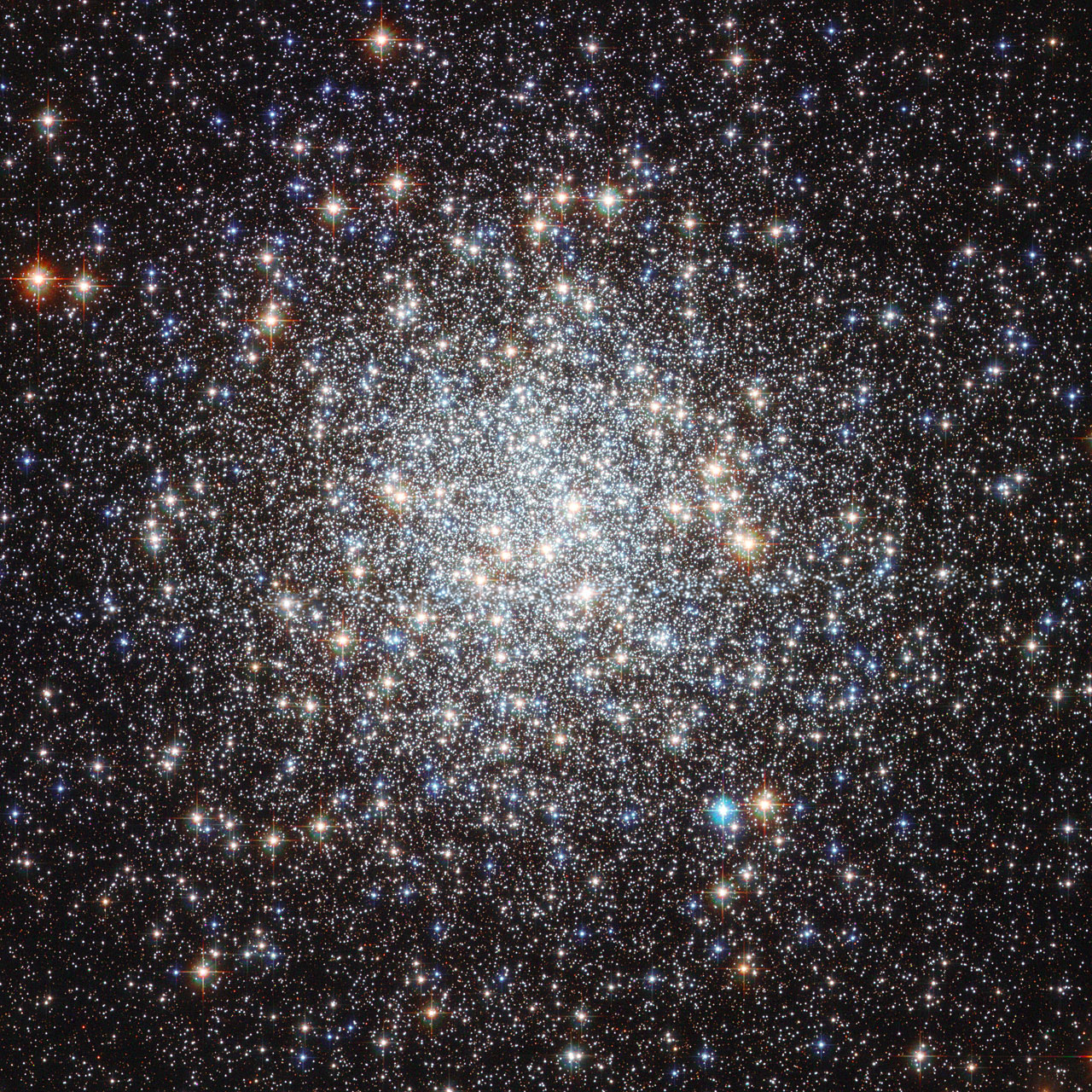
Messier 9 Close-up
See Explanation.  Clicking on the picture will download
 the highest resolution version available.

     M9 is a globular cluster containing over 300,000 stars and has a diameter of roughly 90 light-years.  It is near the center of the Milky Way galaxy and is about 25,000 light-years away.  It is at least two years older than the Sun.

Wednesday, March 21, 2012

Supernova Remnants

     Supernova remnants are important to our galaxy because they have great effects.  They heat up our galaxy and distribute heavy elements within it. This means that they can encourage star formation.  An example of a supernova remnant within our galaxy is the Crab Nebula(5 light years across), located in the constellation Taurus.  It was first noticed in 1054 AD by Chinese astronomers.  It contains a pulsar at its core and is about 6,500 light years away from Earth.
Crab Nebula

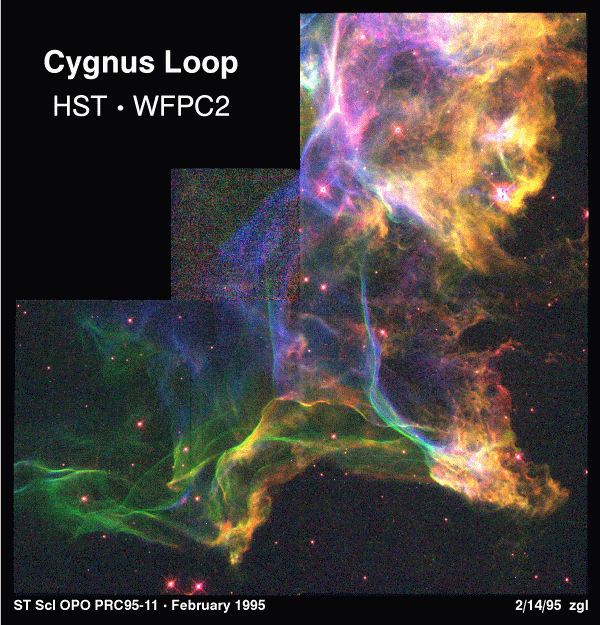
     Another interesting supernova remnant within our galaxy is the Cygnus loop(aka Veil Nebula), which is located in the constellation Cygnus.  It is basically a blast wave from a stellar explosion that occurred 15,000 years ago.  It spans about six times the diameter of the full moon and is 2,600 light years away.
See Explanation.  Clicking on the picture will download 
 the highest resolution version available.
    
     The youngest SNR in the Milky Way is G1.9+0.3.  Astronomers believe it to be about 140 years old and is in the constellation Sagittarius.  It is roughly 26,000 light years away.

Friday, March 9, 2012

APOD 3.7

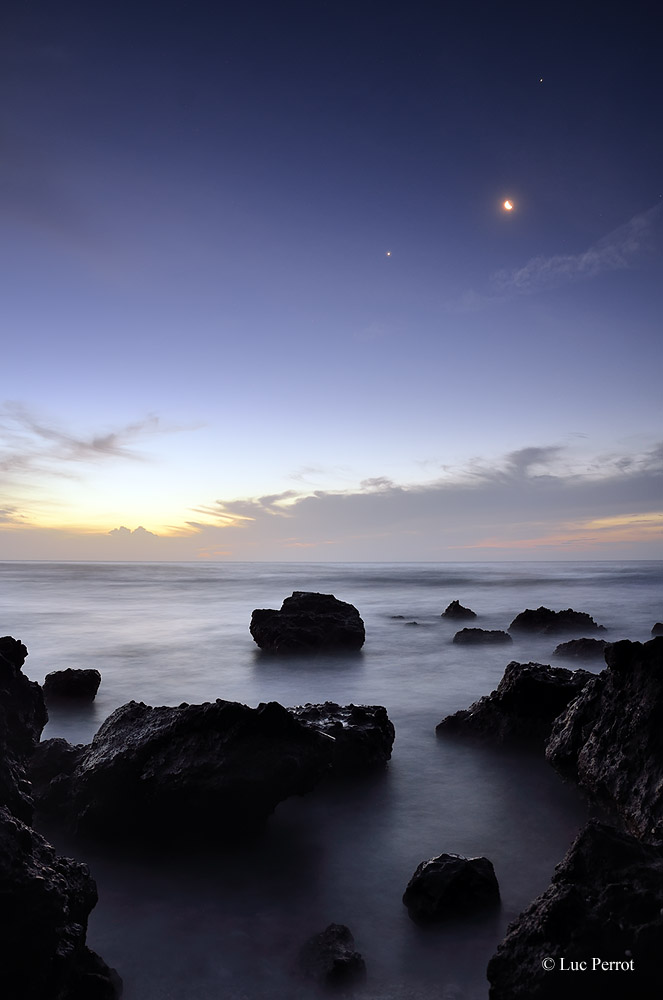
Conjunction Over Reunion Island
See Explanation.  Clicking on the picture will download 
the highest resolution version available.

     This photo was captured on Reunion Island, a French Island that is located in the Indian Ocean.  The photo was taken last week and shows the conjunction of Venus, Jupiter and Mercury.  The planets were joined by a bright crescent moon.  The conjunction is visible anywhere if you look to the west after sunset.  Venus is the brightest, and above Venus is Jupiter which is the second brightest.  Mercury sits right over the horizon and is the most difficult to see.  In order to get a better idea of how to spot Mercury, I found the below picture on http://earthsky.org/astronomy-essentials/pictorial-guide-to-venus-jupiter-conjunction-in-february-march-2012 .

APOD 3.6

Shocked by Supernova 1987A
See Explanation.  Clicking on the picture will download 
the highest resolution version available.
 The above photo is of the brightest supernova ever sighted (twenty five years ago).  The stream of images above shows the result of a collision that was recorded from 1994 to 2009 by the Hubble Space Telescope.  The collision was moving at about 60 million kilometers per hour.  The evolving rings of SN1987A are glowing due to shock from the collision.

Tuesday, February 28, 2012

Maria Mitchell Biography


      Born on August 1, 1818 in Nantucket, Massachusetts Maria Mitchell was the third out of ten children in a Quaker family.  She was mostly self educated except for the short period of time when she attended a school specifically for girls.  At age seventeen she opened her own school (basically just a room that she had rented).  Shortly after she became a librarian at Nantucket’s Atheneum Library. 
     Maria Mitchell most likely developed a passion for astronomy when her father used an observatory to conduct observations for the U.S. Coast Guard.  In 1847, she discovered her first comet.  Aware of her discovery, Maria’s father informed a Harvard professor of this who then contacted the king of Denmark who offered Maria a gold medal because she discovered a comet using only a telescope.  However, before Maria Mitchell could receive the award, it was given to a Roman man because he had seen the comet two days later than her, but his information arrived to Denmark much earlier.  News spread of her discovery and many tourists wanted to see the “woman astronomer”.  In 1848 she was the first woman member of the  American Academy of Arts and Sciences.  In 1850, the Association for the Advancement of Science did the same.  After these accomplishments she was hired by the U.S. Nautical Almanac to compute the locations of Venus.  Later in 1865, she became professor of astronomy and director of the observatory at Vassar College, a liberal arts college in New York.  She passed away in 1889 and is most well-known for the "Maria Mitchell comet" that she discovered.